Showing posts with label Marceline axiom. Show all posts

Sunday, December 7, 2008

The Marceline axiom

Some time ago, I mentioned the Jack Peyton axiom, which basically asserted that once a show lost viewers, they were never coming back.

I have frequently mentioned SON's Marceline here, and her "nostalgia" thesis. It is time it gets immortalized as the Marceline axiom.

As she writes it:

Here's the problem...the "loyal" soap fans, the "real" soap fans don't want to watch a bunch of newbies regardless of talent. I contend that you could bring on a heavenly host of actors with real, true dramatic talent and the people watching soaps now would hate them anyway because they aren't "vets." They'll let a few "core" or "legacy" characters through but in the end it won't matter because it will never measure up to the good ole days. That's nostalgia. It kills the very thing it's meant to preserve.
She goes on to amplify:

Actually the Marceline Axiom can be summed up by the words of Billy Joel in Keepin' the Faith : "The good old days weren't always good and tomorrow ain't as bad as it seems."
These ideas are not inconsistent with my recent blog post, which argued that a part of the problem of soaps is that they grow too old. Burdened with decades of history, they become unwieldy and filled with "saturated logic". There seems to be a pop cultural reality that new generations don't want to enjoy what previous generations did.

Soaps didn't always last forever. The Secret Storm, for example, gave way to The Young and the Restless--after a healthy 20-year run. I'm sure may SS viewers lamented the change, but in the end, something of new relevance had to be created. And Y&R has remained relevant for a long time.

The bottom line, for me, is that I wish the networks weren't too terrified to keep trying. If they have low-performing shows that no longer meet their needs, they should let them go (hopefully giving them grand goodbyes that reflect their long contributions). But they should make new efforts. Most of these will fail, but one fine day.... something will stick to the wall. While doing this they can explore different time slots, different platforms. Because keeping these soaps on during the weekdays for the "housewives" is another form of ridiculous nostalgia.

Saturday, December 6, 2008

Failing to re-invest: Another reason for the decline of soaps

How did we get here? I have shared my obsession with ratings charts, and I hope I have been slightly convincing to at least some folks that the linear ratings decline we have experienced in the US since at least the late 1980s is trans-genre, and not really related to any particular show or creative team.

Some good skeptics have written me to say "But some of this decline has been due to VCRs and then DVRs, which never got counted". That is totally true! Indeed, I have argued elsewhere that when you add Y&R's CBS broadcast plus 7-day DVR numbers plus Soapnet plus legal online streaming (fancast, msn, youtube, globaltv.com) it is actually plausible that Y&R might have 8-10 million US viewers per episode.

Still, that monolithic decline can't be ignored. One irate correspondent wrote me privately to ask (I'm paraphrasing) what I was smoking, and if I was twelve years old and completely unwise. OBVIOUSLY, it is the decline in QUALITY (which may be attributed in part to the youth-grab...the desire to tell quick stories with young newbies, and to chase a more juvenile taste) that caused soap decline. Honestly, I'm not so sure. I'll accept the quality decline, but I remind myself that correlation is not causation. We don't know what is chicken, and what is egg. I'm inclined to think that some of the quality decline is due to REACTIONS to declining viewership and loss of dollars. Newbies are cheaper, for example.

In the end, it is probably non-sensical to have the quality-ratings debate. Clearly, ratings loss has many factors (viewing choices, women out of the home, overall decline of TV, loss of intergenerational viewing, social perception of soaps as 'dated' and 'uncool', etc.). Quality may be a part of that, but the direction of causation is undoubtedly reciprocal. Quality never really reflects ratings...otherwise, shows like St. Elsewhere and Boomtown would have been top-rated (or Masterpiece Theater), and shows like According to Jim would only have lasted a single season.

Anyway, the point of this post is something different. On some soap boards, I (and others) have expressed the idea that a key problem with modern soaps is that they are often 30-70 years old! As much as I love my 35 year old Y&R (and would mourn if it disappeared), I'm also 43...and not the desirable demographic. It would be fine if my Y&R could continue, but there need to be new soaps for the new generation.

As a cultural referent, I mention music, movies and primetime. In none of these genres do we expect the young (desirable demographic) consumers to be enjoying the stuff of their parents and grandparents. Each new generation needs its own music (rock and roll, folk, progressive rock, disco, rap/hip-hop, punk...each was new music for a new generation). The 80s saw St. Elsewhere, the 90s ER, and the 2000s House/Grey's Anatomy. This is natural.

Note, I'm not just parroting Madison Avenue's preference for young eyeballs. For any organization/entity to be viable, it needs REPLACEMENT. As people die, others must be born. This requires that pop culture constantly evolve to be relevant.

Now, I know that some people claim that our chestnut soaps can evolve and be relevant. But honestly, I don't think so. Marceline at SON has called this the over-reliance on nostalgia. AMC shifts to film look, and the viewers complain. GL shifts to the new production model (I realize that show has other problems) and people call it cheap. Y&R shifts to a more primetime feel (thanks, LML!) and viewers call it sacrilege. Part of the reason there is an ENDURING audience for soaps is the familiarity of our soap worlds. Familiar characters, actors, sets, stories...

What this means, I think, is that we need a regular sequence of retiring old soaps, and building new ones. Indeed, during the salad days of soaps, the networks agreed! Of course, making new soaps is a financially risk endeavor. There is a lot of startup cost. And history shows that MOST soaps don't survive very long. The long-term survivors are quite few and far apart. But without that constant new investment, the chance for a new show to "stick" and become relevant is nil.

The consequence of that is what we are seeing now: More deaths than births. Eventually, the genre dies off.

This is not a new argument. The incomparable Irna Phillips said this in a Time Magazine article in 1940, archived by the equally incomparable SteveFrame here:

Today's Children ran for six and a half years. It was still number one with Crossley when Irna stopped writing it. She based her move on the belief that her characters had run through all possible logical situations.

"When you have saturated logic," she says, "you should take your show off the air."

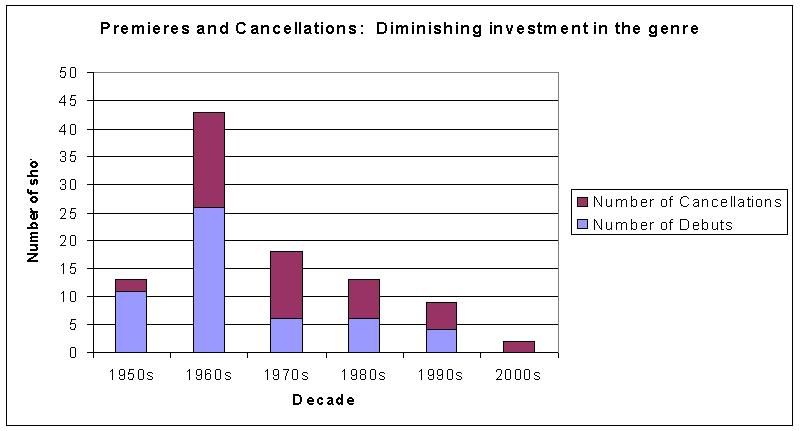
The chart below illustrates the problem.


Look at the 60s and 70s. There was a huge number of premieres (blue), and a huge number of cancellations (purple).

"You can't succeed if you don't try".

I realize that even a decade ago the networks were still trying. Not much--purple begins to outweigh blue by the 80s. Now, we're in a solid purple stage. Maybe I should have colored that red...the bleeding out of the genre.

How do I end this with hope? It's hard. I do note that new forms of soaps (e.g., Roger Newcomb's Scripts and Scruples, all the remarkable fanfic that SteveFrame's SoapsWeb is now honoring--at places like Soapoperanetwork and DaytimeRoyalty) is emerging. But that form is labor-of-love, not labor-of-profit.

I hope, someday soon, the financials might change...and broadcasters might again try. We need more blue on this chart!

Saturday, June 21, 2008

Is Nostalgia killing the soaps/

At Soap Opera Network on May 19, 2008, Marceline espoused the idea that nostalgia is killing the soaps.

So to go off on a tangent. Do you really think the genre is dead? I can think of a lot of forms of entertainment that have been declared dead until something happened to revive them.

Sitcoms were dead. Then came The Cosby Show. They "died" again. Then came Friends.
Sci-fi was dead. Or at least as uncool as soaps until Buffy the Vampire Slayer made it if not cool then at least lucrative. And now Battlestar Galactica is a pretty popular show. And one can easily call Lost a sci-fi show (and a soap.)
Broadway was dead until RENT. And again until Spring Awakening
Movie musicals until Moulin Rouge, then Chicago, Dreamgirls, Hairspray, etc...

My point is I'm getting my ass kicked in another thread for suggesting that nostalgia is killing soaps but I really believe that. And I stick by that. Is it possible that the genre can survive even if these particular shows don't? The concept of the serial drama is thriving in primetime and in other countries and I know that there's a lot of factors involved in making a successful show. But I really believe that the genre doesn't have to die but this version of it has to.
To this, Koos added a concurring opinion.

Nostalgia is totally killing soaps. While I love to see old flashbacks of Bo and Hope from the '80s on Days, or whatever character/show, it's apparent that the flashback should NOT be the highlight of the episode, and it usually IS. Instead of referencing classic moments or even re-airing them, or trying to draw parallels with "new" (read: rehashed) moments that aren't new at all, they should be concentrating on creating classic moments for the 21st century. Nostalgia and an attempt to re-do the past is what's been ruining jazz music, too.

My take:

Yeah, you're right. When I say the genre is dying or dead, I mean THESE shows IN THE DAYTIME on commercial networks, blah blah blah. You're absolutely right. I mean,t he serial format is EVERYWHERE now...I love The Office, and that is as much of a soap as it can be--within a beautiful odd comedy. I love Brothers and Sisters, and that is totally a soap. I really do thing the daily-string format of daytime soaps as they existed on radio and on TV since the 1950s is dead.

Your other point about "nostalgia killing the soaps" is also completely true. But let me parse that a bit (in the way I have been thinking about it).

When LML first came to Y&R (my show) I loved it. She energized the show, goosed up the plots, improved the dialog and pacing. Eventually, LML went south (absolute power corrupts absolutely)--she lost track of history, character, and story momentum.

But here is my point: There were oodles of detractors from LML's FIRST DAY. And many of the detractors had some variant of "she hadn't earned her place in the Bell hierarchy" and "she wasn't consistent with Bell storytelling" and so forth. In other words, those who immediately rejected LML rejected her PRECISELY because she dared to innovate--and because she might not appreciate all the conventions of the soap to that date.

Yet, shockingly, when LML left, and the flower shots returned (and the jewelry and the fireplaces and the instrumental music...) I rejoiced as much as anyone. When a BELL was writing the show again, I was ecstatic. And that's when I realized that the current soaps ONLY survive on the fumes of nostalgia.

Soaps are comfort food...they are the warm tattered blankets left over from our childhoods. They are not attracting new viewers, and the old viewers reject every little microcosm of change. (I'm not saying that's always true here on SON...where there are a lot of progressive people...but more generally it is true). So, we're trying to preserve those blankets until they finally fall apart. In that context, you don't want to change or alter the blanket.

In primetime, my favorite network (until "Tell Me That You Love Me") was HBO. Why? Because it innovated and pushed the envelope. No nostalgia at all. I used to fantasize that daytime would be like that, but Kay Alden said it right at MIT when she said "daytime is not an avant garde medium". It's not. I lives on nostalgia.

The "future of the serial format" will indeed happen...but our 8 remaining, surviving shows....they won't be part of that future. And I'm okay with that.

The soap universe is littered with the skeletons of dead soaps that lived their lives and went away. "Secret Storm", "Edge of Night", "Young Dr. Malone".... Our eight shows will soon join that heap. And then DAYTIME, as we loved it, WILL be dead. That will create time and space for an evolution of the serial form.

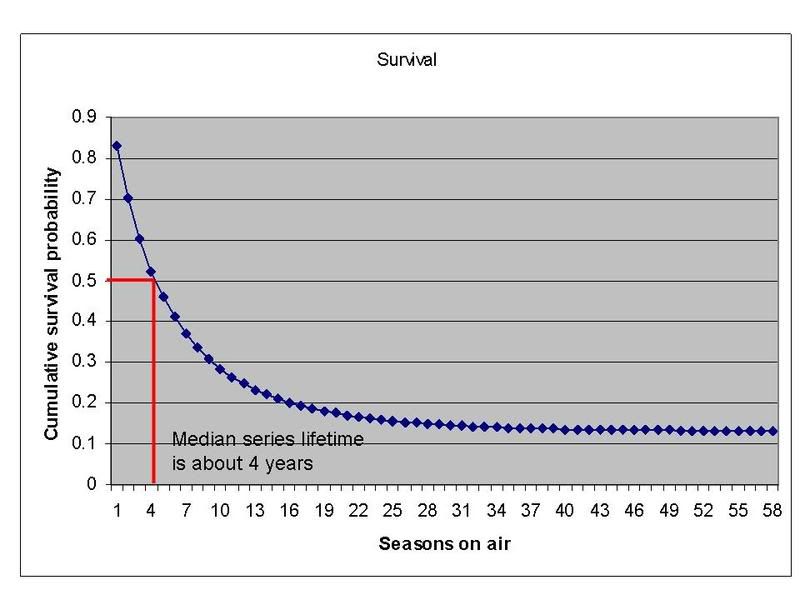
Building on this, here's another statistical perspective.

This figure is based on a "survival analysis" of the soaps' lifetimes (all soaps in America since the 1950s). To make a very long story short, in the whole history of soaps, only 50% lived as long as 4 seasons. That means any soap with more than 4 seasons has already outlived the majority of other soaps. One might also say, such a soap is "living on borrowed time".

There are lots of ways to interpret this figure, and I'm really over-simplifying here. But one way to think about it is that the typical "shelf life" or "relevance" of soaps is less than half a decade. Another way to think about it is "this is a brutal business", and only the hardiest survive.

In that context, it is remarkable that our shows have been on for 30+, 40+ and 50+ years. We have been given such a gift...for them to have so outlived their many compatriots. Those other old soaps had fans who loved them...who lamented the loss of their programs. Some of us have been fortunate to enjoy our daytime addictions for almost half a century.

So, as I'm emotionally preparing myself to let them go (let go of the nostalgia), I'm doing so with gratitude, and with--yes--a little excitement to see the next iteration of the serial format.