Showing posts with label primetime. Show all posts

Sunday, April 19, 2009

Daytime and primetime ratings: Pas de deux?

A user over at SON asked “how tied have the fortunes of daytime and primetime been?” Is there any truth that as primetime declined on a network, so did daytime? The answer seems to be “yes, the fortunes of daytime and primetime have been tied together”. But it is somewhat more complex, because the ratings have shown stronger and weaker associations, depending on the network and decade. Data sources for primetime ratings are, and for daytime ratings are contained in the two threads linked below. Thanks are due to SON users dmarex, ReddFoxx, AllMyShadows and Sean, who helped me figure out which soaps aired on which networks.

I once previously examined primetime/daytime ratings overlap, but this is different. This analysis is more accurate, in some ways, than the overlapping slopes I presented before, for two reasons. First, this analysis breaks it down by network, and second, by now having coupled ratings for daytime and primetime in each season, we could more accurately examine actual year-by-year correlations.


We examined the association between primetime and daytime ratings (aggregate, averaged over all shows) for all networks from 1965 to 2009. I eliminated seasons before 1965 because, particularly for ABC, there was enormous initial variability as the networks grew.

What you see below is an analysis of variance table. The upshot of it is “the story is complicated”. The association between daytime and primetime ratings varied by network and by decade. But, look at that “R-squared” value, which says how much of the variance in daytime ratings we explained with this model: 94%. The legend, for the statistically minded: Dependent variable is Daytime Rating (D_Rat). Independent variables are Network, Decade, and Primetime Rating (P_Rat), and all possible interactions. (Click on the figure to see the full version, if it is truncated)

Photobucket

So, next, I examined the daytime/primetime associations separately by decade and network. The results look like this: (Click on the figure to see the full version, if it is truncated)

Photobucket

Now this is initially confusing, because it shows that the trends really varied by decade and network. “Green” means they changed together; “Red” means they did not or that primetime and daytime actually moved in opposite directions. The best way to visualize this is to look at the ratings, year-by-year, for daytime and primetime together. The next graphs show these: (Click on the figure to see the full version, if it is truncated)

Photobucket

Let’s note, overall, that a story I have told before – that soap ratings really began to decline almost from the beginning – is palpably obvious. ABC soaps grew through the early 70s, rebounded again with Gloria Monty’s GH, and then have declined ever after. In the 70s, ABC’s primetime lineup was growing at a faster rate than daytime…which was struggling with up-and-down. Just as ABC primetime was reaching heights (with Charlie’s Angels and Happy Days) its soaps were in descent. But then, beginning in the 1980s, ABC’s daytime and primetime lineups were yoked, falling in tandem. That association has broken a bit in the 2000s, as ABC primetime has experienced some upticks (Lost, Desperate Housewives, Dancing with the Stars) while the daypart has been on a linear decline trajectory.

For CBS, the story is quite similar. Remarkably, as you can see, the soap ratings were in decline through almost the entire period. That’s as close to a straight-line decline, for CBS daytime, as you’ll ever find. “OJ killed the soaps”. BALDERDASH. That slope of decline is remarkably constant since 1965, and don’t let anyone tell you otherwise. In contrast, CBS primetime was moving in almost the opposite direction all through the 1980s, as Carol Burnett and Mary Tyler Moore and Archie Bunker and their network compatriots created a grand era of gain and maintenance… There was a late 80s fall, then a massive early 90s rescue, then freefall in the early 1990s from which CBS primetime has never recovered. Thus, from about 1993, daytime and primetime fell together. But again, by the 2000s, as with ABC, we see a separation of trajectories. Primetime has managed relative stability (CSI anyone?), while daytime has been in linear decline.

Except in the 1970s, for NBC, daytime and primetime have been a pas de deux. NBC daytime has been in decline, steadily, since the early 1970s. So has primetime, except for slow growth and decline in the 1970s that was followed by the mid-80s revolution that Cosby, Family Ties, and Cheers achieved, along with the early-mid 90s rebound that ER brought.

Looking at both the graphs, and the table above, we see that daytime and primetime had yoked trajectories, more or less, in eight out of 15 “decade-by-network” cells. Moreover, the overlapping trajectories were greatest in the 1980s and 1990s, as larger forces of global, systemic decline drove both sets of ratings down. This association has actually been weakened a bit in the 2000s as, for two networks, the rate of decline for daytime has been somewhat steeper than primetime (for ABC and CBS).

This last fact is, in my opinion, somewhat ominous for daytime. Although viewers are being lost all over the dial, if primetime is has declined at a slightly lower rate, it would seem to suggest extra vulnerability for the soaps. Indeed, I think that may be part of the reason CBS lost patience with Guiding Light.

Thursday, December 11, 2008

What J. Bernard Jones Started (Part 3)

Part 1 is here. Part 2 is here. The original piece that served as inspiration is here.

=========

Part 3. Hope? Despair? Both?

Let me start with full disclosure. I am ardent soap fan. In my life, I have been a regular viewer of Ryan's Hope, Loving, All My Children, One Life to Live, General Hospital, Days of Our Lives (briefly), Search for Tomorrow (briefly), Bold and the Beautiful, and the Young and the Restless. Only the last two are still on my DVR (for a lot of reasons) and have really had my attention since the mid-late 1980s, but I have been ridiculously smitten with this genre since I remember watching TV.

In my dream world, Soapnet would show daytime programs all day long, including a healthy dose of classics. In my dream world, SOD or SOW would be more like "Vanity Fair"--deep, probing, long, analytical articles with perspective. (They would also have people in addition to Eric Braeden on the cover). In my dream world, too, Phoebe Tyler and Myrtle Fargate would both still be alive and sparring over Langley Wallingford. But sometimes, it is more adaptive to let go, and acknowledge reality.

I have been pretty consistent in the last little while, though, about my assumption that, on the current course (important caveat), daytime drama will soon end. I base that assumption (like many of us) on the exponentially shrinking numbers, coupled with the concomitant budget cuts and production decisions that then lead to impoverished content. This latter element, I believe, squanders the goodwill of long-time fans for shows that have been a long part of their lives.

I wish it were not so! In my last post, I tried (indirectly) to explain why it is so important to me to be clear-eyed about this genre. Anticipatory socialization. I have to get ready for the end. It is a defensive posture. Realizing that makes me seem like a Revelations-Armageddon fundamentalist, I apologize....but I really do fear for a Soaps Apocalypse.

=========

So, one of the themes in Jones' blog post, if I may again paraphrase (badly) is that -- judged against what is happening across the broadcast networks (this week's NBC Jay Leno announcement being a perfect example), things may not be that bad for the soaps.

I don't agree. (I wish I did).

It used to be that daytime was profitable enough that it actually helped to subsidize primetime. One could imagine that these days, maybe turnabout would be fair play. The problem is that primetime is bankrupt. There is no money.

In industries throughout America, there are no longer sufficient reserves to "nurture" fledgling or foundering divisions. It is, sadly, time to cut out what can no longer be supported.

So, as the networks look at what costs to shed, they must remove unprofitable albatrosses. If the current economic climate--coupled with shrinking viewership--continue, there is simply no way to PAY for daytime. The hatchet-people will look at these five-day-a-week niche shows and say "uh uh...we can do talk shows".

Because I believe the networks are trying to get out of the broadcast business (by which I mean: abandon the local affiliates, and become cable-only outlets with reduced schedules, from which they retain a higher proportion of profits, and receive subsidization from cable licensing fees), there is a need for a smaller, cheaper footprint.

If you accept my premise that there is no money, there is actually a fate worse than cancellation. It is disembowelling these shows--cutting casts, cutting sets, cutting pay (thereby killing morale). We actually see this latter process happening right now...and it ain't pretty.

That said, I truly am hopeful and optimistic in the long run.

==========

First, I think the Leno experiment really should beget a "Young and Restless" experiment. What I would do...and commit to for a 24-month period...is to run the first-run Y&R episode on CBS every night at the start of primetime (e.g., 8 pm on the east coast). I would continue to broadcast it the next day at 11 am or 12:30 pm or whatever it is in the local market. But the premiere of each episode would be in primetime.

As I have blogged elsewhere, this and similar timeslots have been effective for soaps in other countries. It would have NO incremental cost for CBS. It could ONLY increase both live-views (good for ad dollars) and total viewership for Y&R. It would be a version of the Leno-move.

Of course, I know this will never happen...mostly because of the misogyny and anti-daytime stance of a lot of primetime programmers. They want "hip, edgy, youth-skewing". Okay. Because that is working so well for them....

==========

So, let's take the more apocalyptic view. Every single daytime soap is dead by 2016.

I will mourn, to be sure.

But I think the serial format itself is fairly secure. It goes through peaks (Dallas, Dynasty, 90210 the first, the early seasons of Lost, Heroes, and 24) and it goes through valleys (the latter seasons of all of the above shows). It could be argued that HBO and Showtime's biggest successes have been with dramas with a serial structure. Even the big cable critical hits these days (say Mad Men, Breaking Bad) are dramatic serials.

They are also reinventions. Most of the shows I have mentioned above are not really melodramas, and they're not really female-focused. But that is okay. Those are thematic emphases that worked for the housewives of the 1950s and 1960s...but that entity really doesn't exist in large measure anymore.

The reinvention of the serial as shorter, more limited, more gender-neutral...this simply reflects adaptation ('evolution') to the modern audience. Some of those shows are just terrific. And, by not having 70-year lifespans, they dazzle with "bright shining moments", and then we move on. The Sopranos or Deadwood or Six Feet Under (or, now, True Blood) will linger for many of us as a time of greatness, in part because they knew when to leave the stage. Even the still-marvellous ER...which has had a looooooong run...manages to leave with dignity intact...still seeming like a fairly strong version of itself.

=========

But what about Erica and Marlena and Luke and Laura and Victor and Nikki and Kim and Bob and all these beautiful, iconic "people" with whom we shared every day for so many years?

Well, beyond saying goodbye, it sure would be nice to say goodbye with our heads up...with planned endings on a high note. There is a seedling of hope that life could continue for some of them.

(For me, Soapnet's Night Shift II was just the most beautiful little gem. I wish it had rated better. I'd love to see that used on the broadcast networks, and serve as the model for the next generation of our daytime soaps).

========

The dramatic serial will live on, clearly, well past all of us. The adaptive response from all of us, in my opinion, is to (a) celebrate the past, (b) treasure what we still have, and focus on the positives of our beloved genre in its twilight years, and (c) enthusiastically embrace the evolution. Primetime serials, re-inventions of daytime shows as shorter-arc telenovelas, internet soaps....so much hope! Sometimes, you need to clear the forest to restore it to health.

Monday, December 8, 2008

What J. Bernard Jones Started (Part I)

(Part 2 is here; Part 3 is here).

Daytime Confidential's J. Bernard Jones has written the kind of detailed, analytic, insightful, contrarian essay about daytime's survival that simply begs rereading and rereading.

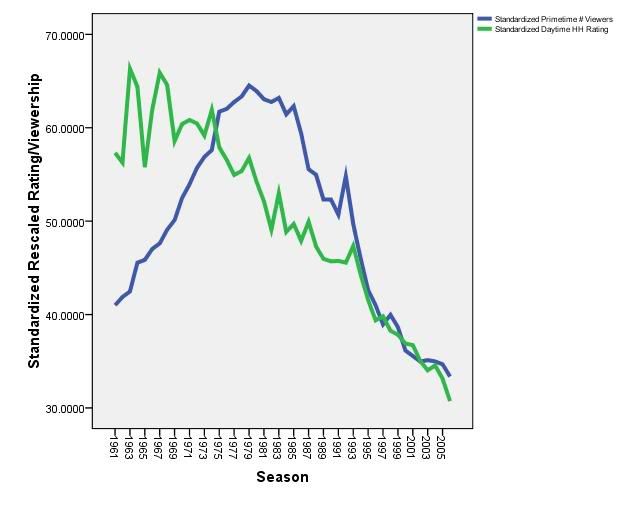
The crux of this post is this picture. It puts daytime and primetime US network ratings on a common scale, and then compares them for the past 50+ years. As you can see, a key point of J. Bernard's is absolutely correct: We must not over-focus on daytime ratings decline. The daytime decline is clearly part of a much larger phenomenon. In this picture, daytime (green) and primetime (blue) have been in a completely overlapping death spiral since at least the 1980s! I'll return to this picture again below.


I don't do Mr. Jones justice by paraphrasing him, but that won't stop me. Basically, he challenges all of us nattering nabobs of negativism who keep proclaiming the imminent end of daytime soaps. Beyond wondering if we're guided by a kind of Schadenfreude (putting it "out there in the universe" to make it true), he suggests that an exclusive focus on daytime ratings ignores the broader context of what is happening to the networks in general. He reminds us that the whole enterprise of network TV is doing badly, so daytime may be doing relatively okay. Moreover, daytime delivers a reliable (if shrinking) niche demographic that no alternative format can deliver. Every attempt to replace soaps, he points out, has yielded an even less successful alternative. Finally, he suggests that retreat only exacerbates the decline of daytime. NBC is in the trouble it is in, he suggests, because it has systematically turned its back and squandered its audience.

His is an essay of such richness and complexity, it really demands careful consideration. I would like to do that over the next 3 blog posts.

In Part 1 (this part), I'm going to examine his thesis that daytime is not the only thing falling. I've been struggling to get a bigger handle on just how much things ARE falling everwhere in the old, advertiser supported media.

In Part 2, I want to consider WHY people (including me) are so intent on proclaiming that "the sky is falling". It is an ardent "death pool" out there on the internet boards (and in the mainstream media, as J. Bernard proclaims). But why? What function does it serve?

In Part 3, I hope to address why -- as much as I love his blog entry-- I think J. Bernard is wrong. The sky IS falling. Daytime is just about done. At the same time, I agree with him...this is just the selection pressure that will give rise to the evolution.

=========

Part 1. On the ubiquity of the decline.

It really is quite striking. J. Bernard is right. Daytime ratings are not the only things falling.

TVBythenumbers has this useful set of data and illustrations:


So it is clear: The audience for TV is actually growing...but it is also GOING: to cable.

Going further back, you'll see something familiar: The same "inverted U" that we see for daytime. US network ratings have been in freefall for a very long time.


Now, since I have the EXACT same data period for soaps, I really want to find a way to compare the two set of ratings. In order to do this, what I need to do is figure out how to put the ratings for daytime into the same "metric" (range of values) as these primetime figures.

To accomplish that, I used a process called 'standardization'. I can explain this more for those who want it, but for now, suffice it to say that I took the daytime average and the primetime average, and (a) I averaged across all daytime shows, (b) I I averaged across all primetime networks, and (c) I converted them into something called T-scores (scores that have an average of 50 and a standard deviation of 10). I return now to the figure I posted at the top of this blog entry, which shows you what happens.


It appears J. Bernard has a point! Look at the period since the early 1990s. The slope of the decline is IDENTICAL for primetime (blue) and daytime (green)!

Juxtaposing the two sets of numbers adds another fascinating insight. Daytime (green) was on the leading edge of the decline, showing clear evidence of decline for the last 3-4 decades. Primetime (blue), in contrast, was continuing to build through the late 70s. But then, when decline set in...the trajectory quickly emulated that of daytime. The amazing lockstep decline of the two figures is...breathtaking!

So, yes, daytime is not alone. In my words: "The sky is falling, but not just over the daypart".

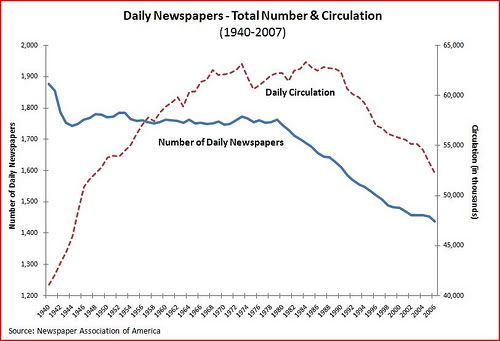
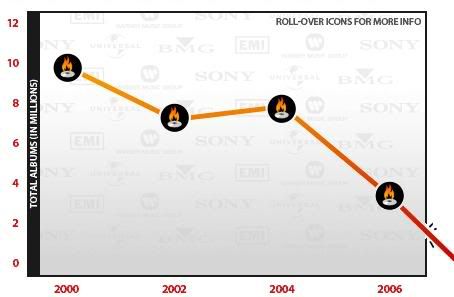
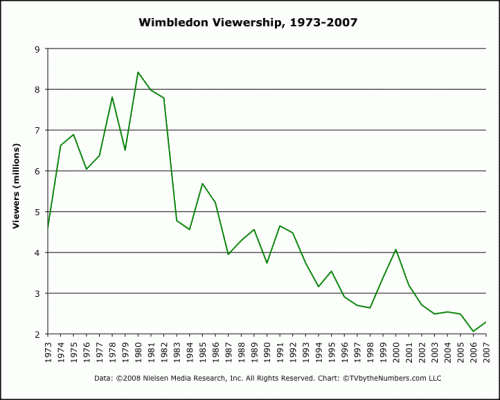
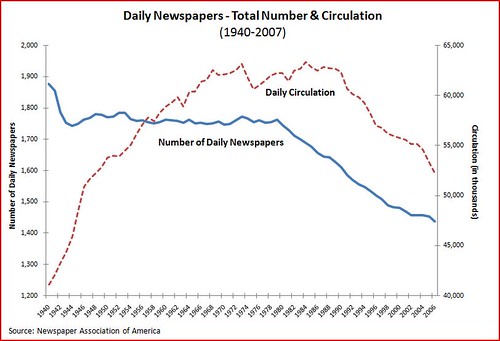
I'll close this post by noting that a lot of old media are going through virtually identical trajectories. It is not just daytime, and that is worth noting. The underlying sociological phenomenon is one we really need to understand better. The figure above from TVBytheNumbers suggests we can understand much of the network decline as "loss to cable". But a similar fractionation and movement to new media seems to be causing a ubiquitous loss to traditional methods of dissemination.

There are newspapers:


There is the recording industry:


Even Wimbledon viewership follows the trend:


So, when your friends tell you "Soaps are sinking because the quality sucks", can you PLEASE tell them it's more complicated than that! J. Bernard told us so, and he is right.