Saturday, December 6, 2008

Failing to re-invest: Another reason for the decline of soaps

How did we get here? I have shared my obsession with ratings charts, and I hope I have been slightly convincing to at least some folks that the linear ratings decline we have experienced in the US since at least the late 1980s is trans-genre, and not really related to any particular show or creative team.

Some good skeptics have written me to say "But some of this decline has been due to VCRs and then DVRs, which never got counted". That is totally true! Indeed, I have argued elsewhere that when you add Y&R's CBS broadcast plus 7-day DVR numbers plus Soapnet plus legal online streaming (fancast, msn, youtube, globaltv.com) it is actually plausible that Y&R might have 8-10 million US viewers per episode.

Still, that monolithic decline can't be ignored. One irate correspondent wrote me privately to ask (I'm paraphrasing) what I was smoking, and if I was twelve years old and completely unwise. OBVIOUSLY, it is the decline in QUALITY (which may be attributed in part to the youth-grab...the desire to tell quick stories with young newbies, and to chase a more juvenile taste) that caused soap decline. Honestly, I'm not so sure. I'll accept the quality decline, but I remind myself that correlation is not causation. We don't know what is chicken, and what is egg. I'm inclined to think that some of the quality decline is due to REACTIONS to declining viewership and loss of dollars. Newbies are cheaper, for example.

In the end, it is probably non-sensical to have the quality-ratings debate. Clearly, ratings loss has many factors (viewing choices, women out of the home, overall decline of TV, loss of intergenerational viewing, social perception of soaps as 'dated' and 'uncool', etc.). Quality may be a part of that, but the direction of causation is undoubtedly reciprocal. Quality never really reflects ratings...otherwise, shows like St. Elsewhere and Boomtown would have been top-rated (or Masterpiece Theater), and shows like According to Jim would only have lasted a single season.

Anyway, the point of this post is something different. On some soap boards, I (and others) have expressed the idea that a key problem with modern soaps is that they are often 30-70 years old! As much as I love my 35 year old Y&R (and would mourn if it disappeared), I'm also 43...and not the desirable demographic. It would be fine if my Y&R could continue, but there need to be new soaps for the new generation.

As a cultural referent, I mention music, movies and primetime. In none of these genres do we expect the young (desirable demographic) consumers to be enjoying the stuff of their parents and grandparents. Each new generation needs its own music (rock and roll, folk, progressive rock, disco, rap/hip-hop, punk...each was new music for a new generation). The 80s saw St. Elsewhere, the 90s ER, and the 2000s House/Grey's Anatomy. This is natural.

Note, I'm not just parroting Madison Avenue's preference for young eyeballs. For any organization/entity to be viable, it needs REPLACEMENT. As people die, others must be born. This requires that pop culture constantly evolve to be relevant.

Now, I know that some people claim that our chestnut soaps can evolve and be relevant. But honestly, I don't think so. Marceline at SON has called this the over-reliance on nostalgia. AMC shifts to film look, and the viewers complain. GL shifts to the new production model (I realize that show has other problems) and people call it cheap. Y&R shifts to a more primetime feel (thanks, LML!) and viewers call it sacrilege. Part of the reason there is an ENDURING audience for soaps is the familiarity of our soap worlds. Familiar characters, actors, sets, stories...

What this means, I think, is that we need a regular sequence of retiring old soaps, and building new ones. Indeed, during the salad days of soaps, the networks agreed! Of course, making new soaps is a financially risk endeavor. There is a lot of startup cost. And history shows that MOST soaps don't survive very long. The long-term survivors are quite few and far apart. But without that constant new investment, the chance for a new show to "stick" and become relevant is nil.

The consequence of that is what we are seeing now: More deaths than births. Eventually, the genre dies off.

This is not a new argument. The incomparable Irna Phillips said this in a Time Magazine article in 1940, archived by the equally incomparable SteveFrame here:

Today's Children ran for six and a half years. It was still number one with Crossley when Irna stopped writing it. She based her move on the belief that her characters had run through all possible logical situations.

"When you have saturated logic," she says, "you should take your show off the air."

The chart below illustrates the problem.
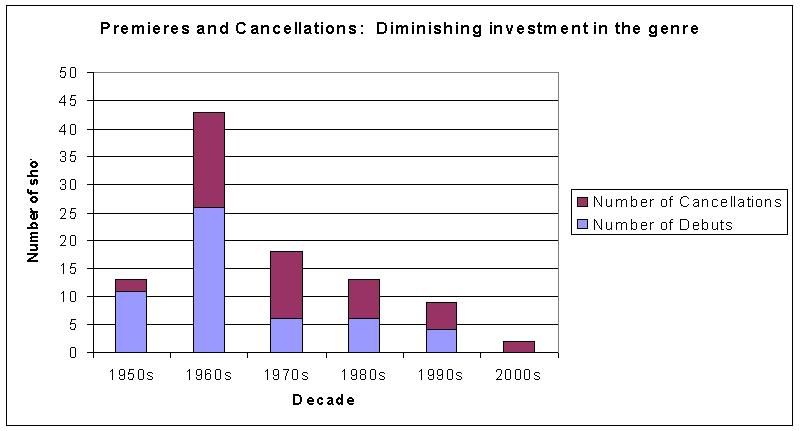


Look at the 60s and 70s. There was a huge number of premieres (blue), and a huge number of cancellations (purple).

"You can't succeed if you don't try".

I realize that even a decade ago the networks were still trying. Not much--purple begins to outweigh blue by the 80s. Now, we're in a solid purple stage. Maybe I should have colored that red...the bleeding out of the genre.

How do I end this with hope? It's hard. I do note that new forms of soaps (e.g., Roger Newcomb's Scripts and Scruples, all the remarkable fanfic that SteveFrame's SoapsWeb is now honoring--at places like Soapoperanetwork and DaytimeRoyalty) is emerging. But that form is labor-of-love, not labor-of-profit.

I hope, someday soon, the financials might change...and broadcasters might again try. We need more blue on this chart!

Monday, December 1, 2008

Don Diamont. An Appreciation.

Okay, so I suspect few will join me in my regret that Don Diamont is leaving Y&R. Especially after Lynn Latham made him a closet-Jew with a Nazi-hiding past...and he killed men with his thighs...well, the character has been at loose ends ever since.

There will be much wailing and gnashing of teeth that Deidre Hall and Drake Hogestyn are leaving Days...but honestly, it its' own way, the dismissal of Diamont is almost a serious a bellweather of how deep the daytime funding cuts are going.

This appreciation is in several parts.

1. The prurient part

Soapy, at http://www.soaphunks.net, has delivered the ultimate tribute to Diamont in this dimension. So I'll let his pictures tell 1000 words.

His video repository is here.

His photo repository is here. That's got everything from Playgirl and Speedo shots to the more recent stuff.

Soapy has archived the classic Brad In A Cage tale, which I am embedding here.


Soapy has said that Diamont was a very important part of his coming-of-age. In general, it is always sad when someone we have shared the last 2+ decades with leaves.

2. The beginning of the end

I suspect Diamont was undone by a story written for him by Lynn Latham. A precis of this story can be found at soapcentral.com and is appended to the end of this post. It is a horribly convoluted tale that played havoc with Diamont's character, and is considered the worst example of Latham's Y&R. Because it called into question Brad's character, he was never really a viable lead again.

3. Why Diamont will be missed (by me):

This raises many questions:

1. With Abby getting mentions (and Ashley in Europe to get her now), one would think her daddy would stay in town. I wonder if Abby will stay in Europe, and whether Brad will go be with her? It seems totally odd if Abby returns and Brad leaves at the same time.

2. With Brad in a hot front burner story right now (Phyllis' scheme) it seems like his story should be building (not declining). So, this is odd.

3. Colleen is titularly an Abbott...but with her daddy leaving too, Colleen has nary a genuine tie in Genoa City. Her relationship with her best friend Lily was harmed when she went after Daniel. She has never had meaningful interaction with the other Abbotts...not in ages. She is in no relationship, and has no meaningful job. I feel the writing is on the wall for this character.

4. It suggests, contrary to my hopes, that Sharon-Nick-Phyllis is moving to the front burner. I want Sharon and Nick to be kept apart for many years yet...but it seems like that won't happen.

5. It raises the question of whether the Brad character was soooooooo ruined by what Latham did to him (i.e., the initially intriguing backstory that degenerated into Nazi silliness), that MAB could not find a way to rescue him at this time.

6. Diamont was one of the most publically supportive of Lynn Latham. For example, in an interview with the 7/16/2006 Pittsburgh Post-Gazette, this report featured a glowing interview with Diamont:
Latham, who took over at "Y&R" in the past six months, said she didn't do a full-scale housecleaning as some new daytime executive producers do.

"I have leaned very heavily on the actors, too, to help me fill in on the story," she said.

Actor Don Diamont, who plays Brad Carlton, said that's rare.

"To Lynn's credit, by the way, that's not something you'll come across? with every head writer," Diamont said. "Lynn said, 'Can we have lunch? I want to meet each and every one of you and hear what you have to say about the character you've been playing for 20 years. Who is he?'And that's a rarity."

I wonder if he is being punished at some level for disloyalty?

7. I hope this is a "temporary" exit (as in jail time, or going to see his ailing mother, or returning to Italy because he can't get over losing Sharon...something like that). I am fine if he is gone for years...but I don't want this legacy character totally gone.

8. Most importantly: This is a sign that cost-cutting has returned to Genoa City! Back in the day, Brad would have been kept around...even without strong story potential (see Doug Davidson). Now, apparently, that won't happen.

Why do I call him a legacy character? Why do I think his absence will leave a void in the canvas?

Twenty years makes you a legacy character. (23, if you don't count his time off).

His deep ties to just about all of the core families on canvas (fiance of Nikki, husband of Victoria, potentially the father of Reed...if Victor tampered with the results, legal father of two of the scions of the Abbotts--Colleen and Abby, lover of Sharon, rival of Victor, rival of Nick, rival of Phyllis, rival/ally of Jack, ex-husband (maybe some embers still glowing?) of Ashley, ex-lover of Olivia).

I'm not totally lamenting the absence...it is okay to rest the character. But it is a sign that even Y&R needs to trim costs. And is a sign that a once-important character was seriously damaged by the past regime.

--The Grugeon Reliquary story from soapcentral.com:

I end this post with a brief quotation from that soapcentral.com character summary. It summarizes the Grugeon Reliquary tale that did Brad in.

Victor hired Paul Williams Investigations to check on new son-in-law Brad's past...They discovered in Cleveland, from a high school annual photo, that this person was not the real Brad Carlton

Clues uncovered showed that the Kaplan family, including their 15 year old daughter Stephanie had been murdered in Parma Ohio, and 18 year old son George was sought for questioning. Three months later George's body was found presumed the victim of a hit and run, the police thought they had the murderer, and at the same time Brad Carlton joined the Navy Seals.

Brad later revealed his side of the story: His mother Rebecca Montalcini was born in Rome to a wealthy Jewish family. Rebecca was a child when Mussolini invaded Italy, her family lost everything and was sent to a concentration camp, where Rebecca survived because she spoke German and had the knowledge to catalog the fine art which was confiscated from all Jews. Once they were free, Rebecca testified at war crimes trials against the commandant who was put to death. She made it her mission to remember where the millions of dollars worth of art ended up and get it returned to its rightful owners.

Avoiding death threats, Rebecca and her sister Isabel immigrated to the US where Rebecca met Arturo (who had Americanized his name to Arthur) Kaplan. They were married, lived in Parma, Ohio, and had children George and then Stephanie. Somehow the Nazis tracked them down and Isabel was mistaken as Rebecca and murdered along with Arthur and Stephanie. George and Rebecca hid out from the Nazis and police in George's friend Brad Carlton's basement until his father threw them all out.

They were living in an abandoned farmhouse when George and Brad were out hunting food, and Brad was hit by a car and killed. George then switched ID's with Brad and Rebecca took the last name of Carlton too. Once Brad's decomposed body was found, the police ID'd him as George and stopped the investigation, thinking they had the killer.

George got his mother connected with the underground and joined the Navy as Brad.

Eventually he ended up in Genoa City with Rebecca still in hiding....Later, Brad's daughter Colleen confronted him with what she knew about his mysterious past, and accused him of kidnapping JT.

Brad explained his past to Colleen, then hustled her and Abby off to the private jet where they met his mother Rebecca, and were jetted to safety in Hawaii. Meanwhile Sharon arrived at Brad's to find the door ajar, and being mistaken for Brad's wife, was kidnapped and held captive with JT in Cleveland. Brad received a call from the kidnapper telling him they had Sharon.

Victoria and Brad went back to Newman, and brought Nick and Paul in on the case. Nikki volunteered to take Noah away on a mini-vacation to see her sister Casey to keep him safe and oblivious to the fact that his mother was missing. Brad had to explain to all his past as George Kaplan and that the kidnappers wanted an artifact called the Grudgeon Reliquary. Then JT was dumped on Brad's doorstep as a warning.

After they wasted days trying to track down the Reliquary on the Internet and through art dealers, Victoria decided to create a fake using two other similar Grudgeon pieces. They took the fake to Cleveland and Nick met the kidnapper and his henchman for the exchange at a church.

Meanwhile, misled by the kidnappers, Brad, Paul and JT were converging on the shipping crate where Sharon had been held which was booby-trapped with explosives. They disarmed it in time, then arrived just in time to rescue Nick & Sharon as explosives attached to Sharon were about to detonate.

Brad ended up fighting with the bad guys, and killed them both (with his thighs, in a headlock) after the head guy admitted he was Oscar Volkmann, son of the Commandant who was executed after Brad's mother Rebecca's testimony. All arrived safely back in GC and vowed to never tell what went on for everyone's safety. Then Brad and Victoria told Victor and Nikki, and Nick told Phyllis.

Victor became determined to find the Grudgeon Reliquary. He and Brad posed as art connoisseurs searching for the reliquary. After some tense moments they managed to fool some art thieves and purchased it.

They brought it home to Rebecca who found an inscription which was in code. Thanks to Colleen confiding in her art history professor and lover, Adrian Korbel, he solved the puzzle which revealed a treasure worth billions that was concealed in the catacombs in the Czech Republic.

Sunday, November 30, 2008

Another ratings reality check (or don't blame Ellen Wheeler)

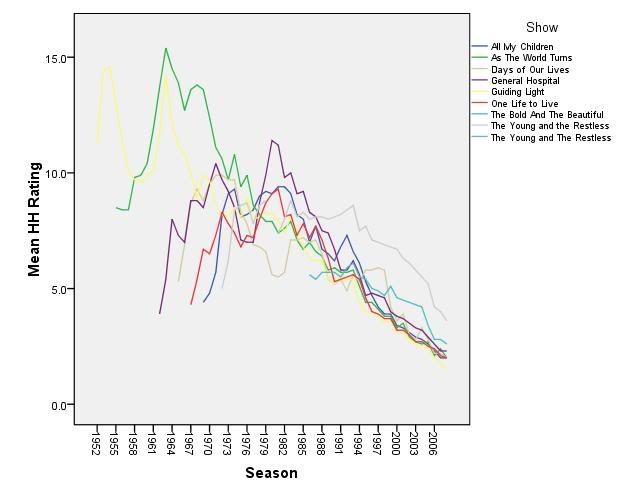
Here, in the past, I have put up ratings graphs that show the ratings (household, per Neilsen) for our soaps in historical context. I updated the graph with season-to-date ratings. Showing only currently-living soaps, here are the ratings trends as of 11/2008:


If you ignore the 1950s (where rapid expansion of televisions and television options meant the ratings fluctuated widely, and really aren't so comparable to the "saturated market" ratings we've had since the 1960s and beyond), you see a very clear general trend of growth through the mid-1970s, and then a very clear decline trend ever since. Now, there are some interesting local peaks (GH in the early 1980s; Y&R in the early 1990s), but for the most part all the soaps have moved in lockstep, downward, since the mid-70s.

This is so relentless and universal a trend IT CANNOT BE BLAMED on the creative state of any show or any regime! We really can only blame things like the growth of tv (cable) and non-tv (internet, games) options, the movement of women out of the house, the reduction in intergenerational viewership due to multi-TV households, etc.

The eye does not lie. That is pretty much a STRAIGHT LINE, and it began in the late 70s or early 80s. THERE IS NOTHING SPECIAL about the decline we see today. It is nothing but a "dying off" process (loss of viewers without replacement, at a fairly steady rate) that began almost 3 decades ago.

Oh, if only I could have a nickel every time someone said "the creative state of soaps today is so lousy, and that is why we're losing viewers". Uh uh! The rate of loss is no more significant now than it was 20+ years ago--when some shows were thought to be at Marland-esque, Bell-esque etc. creative heights.

Oh, if only I could have a dime every time someone said "if only TPTB would do such-and-such, ratings would go up." (This probably includes promotion...although I think more promotion might be able to be the one thing that built slight audience growth). Uh uh. NOTHING--not even the blockbuster of Luke and Laura--could stem the trend. If you look at GH in the early 80s, you see that it definitely spiked TEMPORARILY due to that incredible storyline. It clearly brought new viewers into the system. But it COULD NOT LAST (and it didn't), because larger demographic trends were dragging the shows down.

And I want a dollar everytime someone blames OJ Simpson! If you focus your eyes on the early-mid 1990s in the graph above. I defy you to find any significant deviation in HH ratings decline trends! If OJ had not existed, the declines would have been EXACTLY the same. I'll try to show this more clearly below.

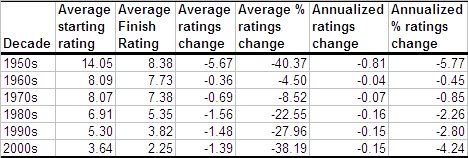
The table below tries to show the phenomenon in a different way. Averaging across all shows that were on at any given time, the figure shows the minimum and maximum ratings in each decade. Again, don't trust the 1950s data, because the new technology (TV) and explosive growth of households and viewing options really messes up those numbers


First, focus on second-last column, annualized ratings change. Note that, in every decade, the trajectory has been decline. Second, note that the rate of decline has been EXACTLY THE SAME in the 1980s, 1990s and 2000s. The rate of decline DOUBLED from the 1960s to the 1970s, and it DOUBLED AGAIN in the 1980s. Since then, it has been a fairly CONSTANT loss of 0.15 per year.

From this perspective, it again reminds us THAT NOTHING SPECIAL is happening now. Soaps are not in some "sudden freefall". They are in a constant decline.

On the other hand, the far right column shows us the consequences of this steady viewer loss in the face of a smaller-and-smaller shinking base. This shows us the % of viewers lost annually in each decade. (In other words, of the viewers who started the decade, what percent of those viewers were lost, on average, in each year of that decade?). As you can see, because the number of viewers is smaller and smaller, the steady loss of viewers represents an ever larger proportion each decade.

The current decade evinces about an annual 5% loss...which means (in the 2000s) the steady viewer loss indicated that, of those who started the decade, only about half remained as viewers as we near the end of the decade.

We see this most alarmingly in another post I shared recently, that said GL/ATWT lost about 30% of their viewers in the last year. (Canadian TV Guide further added that GL lost about 21% of its desirable demo during the same period). Those proportions seem apocalyptic...but they are really only that large because of the steady rate of viewer loss over a smaller and smaller viewer base.

Does that mean, for example, that Ellen Wheeler is NOT the anti-Christ? Well, from a long-haul perspective, GL is not visibly declining at an appreciably faster rate than the other soaps. However, if you take a magnifying glass to that "yellow line" representing GL in the graph above, you see that GL was never really above the middle of the ratings pack, and tended to the bottom of the pack twenty years ago. Whoever oversaw THAT relative loss of ranking is much more responsible for where GL is today than Ellen Wheeler. On the other hand, if you peer at 2007-2008 with your magnifying glass, you'll see that the distance between bottom-ranked GL and the next highest soap has widened just a bit. GL has declined just a little faster than the other soaps. (From the beginning to the end of this year, GL lost 30% of its viewers, but Y&R lost about 25%). That doesn't actually seem like an impeachable offense.

Seriously, the overall market trends are driving this. I honestly believe Douglas Marland and Beverley McKinsey could return from the beyond, and GL ratings would still be where they are. The production model could have stayed the same or become more sumptuous, and still the ratings would be where they are. That is because demographic and social forces outside of soaps are causing all of this. In that sense, Wheeler's new production model is a bright strategy! By reducing the cost of producing a soap that would do no better if there were more investment, she at least keeps people employed a little longer.

Sorry for this long-winded post, but there are two final conclusions.

A. Follow the lines, and draw your conclusions. Those of us who love the soap genre MUST prepare to let go SOON. The trend is unmistakeable, universal, continuous, and is based in at least 30 years of history. If we want our soap fix, we'll have to find it online, or in primetime, or in books, or whatever. This TV business model for soaps is utterly unsustainable.

B. We have now reached the point where the ratings are so low, most soaps have needed to implement austerity plans. The cost-cuts are so deep that viewers are noticing (GL's production model, ATWT's minimal sets, ABC's 50% cuts, Days' 40% cuts and firing of its' signature stars).

It may be time to send a different, activist voice to the networks...which is to let our "loved ones" die. We understand that the business is no longer sustainable, and we'd much rather see our shows go out on a strong note, than dwindle into local-access-cable-amateur levels.

Even if active decisions to pull the plug do not happen, our soaps will be gone very-very soon. GL and ATWT are rumored to have 2009 contract extension possibilities (bringing them to 2010), but a September-2009 sayonara for GL is widely rumored. So, too, Days' contract renewal has been much publicized as going to September 2010, and Ken Corday seems very pessimistic about further renewals. It seems to be dependent on certain performance benchmarks that seem (given the figure above) unlikely to occur. If GL/ATWT/Days are all gone by 2010, that leaves us the ABC lineup and Y&R/B&B. With ABC is massive cost cutting (50% cuts and the cancellation of SuperSoapWeekend), these numbers strongly suggest that it hardly seems likely that they can lag much behind in cancellation.

Thursday, November 27, 2008

Soap budget cuts: Salvation or sign of the end?

(Small non-sequitur: I have updated my cross-over list and GLBT list and image gallery to reflect some late-in-2008 additions)

So, this last week brought revelations that NBC required a 40% budget cut (from print edition of Soap Opera Digest) from Days of Our Lives for renewal, and ABC has recently asked for up to 50% budget cuts from cast and consultants. Guiding Light had much publicized budget cuts last year (e.g., 50% cuts in writing staff; hence, the new production model). I think this is not a sign of hope ("teamwork to save the show"), but the futile last gasp.

It seems that Y&R and B&B aren't going through such horrible cuts. Are they being "saved" by relative success on the foreign sales market? My sense is that the official story is that foreign sales are nice, but "chump change". They do not apparently offset the bulk of US production costs. At the same time, when I look at the two most popular international shows (Bell shows), I (and others) seem to see them spending MORE not less money. Their ratings (esp. B&B) are not high enough that they should be protected from this economic downturn. So maybe the foreign dollars do matter?

I also assume that the production houses may be willing to take less profit...as long as they break even...during a downturn like this. So, this leads me to conclude that ABC and NBC and P&G are not even breaking even on their soaps?

Could Y&R and B&B more quietly be asking for pay cuts from their actors? I wondered if this was what he was alluding to in a recent TVGuide.com interview...saying "I am happier with the storyline, I have to say. Much happier. I really mean that. I'm happy along those lines; along some other lines, no. But that's a different story."

I worry, actually, that when the pay cuts hit Y&R, we'll lose many of our starts. In recent years, Braeden, Scott, Woodland, Case, Morrow (others?) have all walked when contract negotiations fell apart. Heather Tom left the show when her pay cut (reduced guarantee; used less) happened.

I fear there are performers on Y&R who will just walk. Therefore...all the headlines that "Drake and Dee" are getting now....I expect them to repeat for "Eric and Melody" before the day is done. With that, the heart of these shows is expunged...and there seems little value in continuing to follow the empty shells that remain.

On the other hand, maybe the sheer scarcity of roles these days keeps some actors as a captive force on their shows. Is there another game in town?

I was actually in a situation in the last year where the economic downturn led to the issue of across-the-board paycuts being DISCUSSED. It's one thing to say theoretically, but when you suddenly have to live on less money...it's a hard pill to swallow. Especially if you have the same workload.

With that in mind, however, you're more apt to swallow this if there is no other game in town...and if your previous earnings have not made you independently wealthy.

So, unfortuntely, this becomes the classic "over the barrel" scenario: Do it, or have no job....and good luck finding another. That is essentially what Ken Corday said about his show: "Demonstrate teamwork or... goodbye".

For me, in the end, this all feels like we're closer to the end than I thought (for the genre).

We see this in many failing industries. The last step is "employee concessions". In some industries (like air or automobile) it CAN work because there is a hope for economic recovery.

Not for soaps. Sure, there may be more advertisers in the future, but the advertising game has changed. They value broadcast advertising less. AND nothing happening here will bring back soap viewers. They're gone forever.

I really thing the Days scenario describes where all of daytime is headed. These massive cuts will eke out another 18 months or so...and then the shows are gone. We've seen it at Days/NBC, we're seeing it at ABC now, and we saw it last year and before with CBS/P&G. Only the Bell soaps seem less publically to be going through this. (Years ago, Shaughnessy said they were doing significant cost cutting, but it was their goal for us not to notice it on screen. That began the era of use of fewer sets....but these days we seem to see MORE sets).

In that sense, I think all this cost cutting is heroic, but ultimately futile.

Remember, all soaps are going to end by 2016 anyway (insert wan semi-smile)

Wednesday, November 26, 2008

What Barack Obama should learn from Lynn Latham

I hope that is not too provocative.

Yesterday in Chicago, Barack Obama announced more members of his economic advisory team. A large number of his team members served in the Clinton and even Carter administrations...prompting some critics to argue that this is not the "change" Obama promised.

To this, Mr. Obama replied, in part

The reality is is that sometimes policymaking in Washington can become a little bit too ingrown, a little bit too insular. The walls of the echo chamber can sometimes keep out fresh voices and new ways of thinking. You start engaging in groupthink. And those who serve in Washington don't always have a ground-level sense of which programs and policies are working for people and businesses, and which aren't.

This board will provide that fresh perspective to me and my administration with an infusion of ideas from across the country and from all sectors of our economy, input that will be informed by members' firsthand observations of how our efforts are impacting the daily lives of our families.

Later, he said

And I suspect that you would be troubled and the American people would be troubled if I selected a Treasury secretary or a chairman of the National Economic Council at one of the most critical economic times in our history who had no experience in government whatsoever.

What we are going to do is combine experience with fresh thinking. But understand where the -- the vision for change comes from first and foremost. It comes from me. That's my job, is to provide a vision in terms of where we are going and to make sure, then, that my team is implementing it. I think that when you ultimately look at what this advisory board looks like, you'll say this is a cross-section of opinion that in some ways reinforces conventional wisdom, in some ways breaks with orthodoxy in all sorts of ways.

And that's the kind of discussion that we're going to want. We want ideas from everybody. But what I don't want to do is to somehow suggest that because you served in the last Democratic administration that you're somehow barred from serving again, because we need people who are going to be able to hit the ground running.

I am mindful of how much this sounds like early language from Lynn Latham at Y&R. When Latham first joined the show, it was sort of "under cover of night", first appearing as consultant, then later as one of three headwriters, then official top-dog headwriter, then later, executive producer.

In one of her earlier interviews, there was a respect for tradition, combined with a freshness of perspective, that was really inspiring (at least to me). Moreover, I found the energy she brought to early Y&R quite positive. I really liked that -- while she was new (but herself experienced) -- she was working with whole legacy team! Of course, history has since shown that she was not sincere about this...rapidly cutting loose her ties to the show's heritage, and creating an increasingly inconsistent mess with bad management.

But that early interview with Latham was great. In the 6/27/06 issue of SOW she said, in part:

Respect for history

1. Her "number one rule" in making changes was to "respect the history of the characters and the series". (Sadly, that seemed to have stopped later on)

2. It looked like she was working with the people in charge. In response to the new sets, moving cameras, actors walking and talking, Latham said many had created the changes. She said changes were initiated by Bill Bell Jr., Steve Kent of Sony, and CBS Daytime head Barbara Bloom. They wanted to pick up the pace in storytelling and production. Apparently, everyone was agreed on these changes, and worked together. (What I didn't pick up, at the time, was that key leaders like Kay Alden, Jack Smith and Ed Scott were missing from her list of collaborators)

3. She pledged to work with existing sets and team leaders, just reinvigorate them: She said that Bill Hultstrom had actually redesigned Newman Towers so that characters could be followed moving through elevators and offices. She also noted that they added the break room because she, too, has her best conversations with colleagues by the office microwave. (She also notes the break room is more upscale than hers...no Formica, hanging wine glases). (Now, in retrospect, we know that the Formica was probably as much a politically correct desire to get artificial and anti-green and poverty-encouraging materials off the set as anything else. Latham later expunged plastic water bottles, diamonds, and indoor fires for all the same reasons.)

Freshness

1. The biggest change, she said, would be replacing traditional Y&R stylistic devices ("slow arcs and pans at the beginning of scenes") with more "dynamic blocking and camera movement". She said they would be cutting away sooner, without multiple reaction shots. She called this "Y&R Plus", because characters would get more air time in this active style. "I love the actors here so much, I always want to see them more!". On this note, she said they dropped the"waiter shot", where the camera follows a waiter until it finally settles on the actors. So, too, closeups of gorgeous floral arrangements are also gone. (Interestingly, on 12/27/2007, when the Bells reclaimed the show, lingering scenery shots immediately reappeared. As time has moved on, these are no longer as common as they used to be)

2. From the writing perspective, she said they would be writing more movement into the scripts, eliminating greetings and exits, and they wanted each day to end with a "tag" (mini-cliffhanger) to encourage more days of viewership. (In the end, the pace got so fast that...if you missed a day...you were likely to say "huh? when did that happen? It didn't encourage more viewership...just more confusion.)

3. As a result, wardrobe was having to contend with many more costume changes.

In another interview from this era, the Pittsburgh Post-Gazette (7/16/2006) reported:

Latham, who took over at "Y&R" in the past six months, said she didn't do a full-scale housecleaning as some new daytime executive producers do.

"I have leaned very heavily on the actors, too, to help me fill in on the story," she said.

Actor Don Diamont, who plays Brad Carlton, said that's rare.

"To Lynn's credit, by the way, that's not something you'll come across? with every head writer," Diamont said. "Lynn said, 'Can we have lunch? I want to meet each and every one of you and hear what you have to say about the character you've been playing for 20 years. Who is he?'And that's a rarity."


By the end of Latham's tenure, just about EVERY legacy writer on the show (excluding, I think, Natalie Minardi Slater, Eric Freiwald/Linda Schreiber, and Sandra Weintraub) was gone. The new writers few through in a revolving door that...sometimes...bewildered even them (with a lack of writing time and minimal opportunities to get to know the characters she was actually writing for). Tom Casiello wrote (originally here, but that post now requires "friend" adds at Myspace). The point is that--by NOT relying on the benefits of experience--you actually burden and burn out the fresh perspectives. They NEED experience to lean on!

I chose Young and the Restless.

What I found when I started was a show in deep transition. It happens. I survived two transitions at As the World Turns, and one at One Life to Live. They're tough, but they're part of the nature of this business. Lynn Latham had just taken over EP duties (along with being HW), a lot of longtime Bell writers were let go (and many were rumored to be on their way out, so I only had a few weeks to pick their brains and learn all I could from them), there was a mandate to move the show into the next generation, and while all of this seemed thrilling and exciting, there was part of me that said: "What have I signed up for?"

While the fan in me wondered why you'd want to fix something that's not broken, the writer in me could appreciate and respect the desire TPTB had to amp up the watchability factor. So I thought to myself: "Self? For better or worse, you have to give this your all. Read up on the history, learn about these characters, give them what they're looking for, dive in head first. You may stumble now and then, but you're a writer. You can do this."

And I did. But then production fell behind... the writers fell behind... sometimes we'd have LESS THAN TWENTY-FOUR HOURS to write an episode. Whatever was going on at the top trickled its way down to all of us, and we were under a gun, blindfolded and typing madly in the pitch black. Sometimes completely left to our own devices. I spent most of my week sitting around waiting to find out what I was supposed to do while I read up on fan history pages, and the last few remaining hours doing more research than I've ever done -- but NOT on Y&R! On deafness, on epilepsy, on Judaism. Everything BUT the characters and emotional content in my episodes. I'm not foolish or arrogant enough to be able to say I know what caused this behind the scenes, but whatever it was, it led to me ripping out handfuls of hair on many a Saturday night at three o'clock in the morning.

I could clearly see that whether it was my fault or not, I would not last through my first cycle. Working under those conditions AND trying to learn the rhythms and practices of a show both behind the scenes and in front of it, was just too difficult a task. But this was not a complete loss, by any means. I'm very grateful for my thirteen weeks there because I met some pretty amazing writers who were kind, welcoming, and ready to help me with character, with motivation, with history. Writers who would respond to an e-mail immediately, or even answer a frantic phone call at eleven o'clock at night. Kay Alden, and Janice Esser, and Natalie Slater and Sara Bibel.

It led to a profusion of excellent viewer comments like this:

Just wanted to say that I think they've destroyed the show with the plot driven writing, full of continuity errors and characterizations which change depending on who wrote what episode and what story is being told.

I am a big fan of Lynn Latham from Knots Landing and Homefront, but she's not fit for daytime. Major events like Jill and Ji Min's first love scene or Mackenzie's abortion now happen during the commercial break. What we get on screen is endless drivel about Clear Springs, MEEthane gas or reliquaries.

It was a mistake to completely uproot the show instead of fine tuning it. Now nobody knows the history of the show or what made it successful. Bill Bell must be rolling in his grave.
So, how do I tie this all back to Obama? Because I really do feel (obviously in very different spheres...I don't mean to trivialize Obama's huge mission) that early Obama sounds an awful lot like early Latham...which is a good thing. He's trying to respect experience and to select the things that have worked in the past. At the same time, he wants to innovate, bring in fresh perspectives...and he cites HIMSELF as the genesis of many of those fresh ideas. Bravo! Work with old, encourage the new.

Six months after that Latham interview above, essentially all of the "old guard" were gone. Left to her own devices, without the benefits of experience, the show imploded. Let's hope that Obama tries to mix innovation with experience for the next eight years!

Monday, November 24, 2008

Will ATWT Brian's potential be realized?

I was excited to learn about the Brian story on ATWT. First, as Roger Newcomb has said, it is the kind of dysfunctional intergenerational mess that is at the core of soaps and ATWT. To have a gay element to that helps to end the marginalization of the show's "gay storyline".

But there are warning signs that this story is not going to be subtle, nuanced, or authentic. It seems Brian is going to be the sleazy guest villain of this quarter, bilking Lucinda while trying to shag Luke...which is already raising groans of disgust from the soap quarters I visit.

From cbs. com, here is the most recent beat of the story:

Wednesday, November 19, 2008

Lily and Holden visit Lucinda at the hospital, where Lucinda and Brian have just confirmed that they’ll be getting married. Lily is alarmed at the news. Brian goes to call the judge and run some wedding errands as Lily has a moment alone with her mother. Lily explains her concern and Lucinda defends her actions. Lily understands that Lucinda doesn’t want to die alone. Lily wants ­Lucinda to be happy. Brian has Lucinda sign a pre-nuptial agreement to show that there are no strings. He gives her his Princeton class ring and they exchange vows. Lily and Holden are moved. Meanwhile, Noah helps Luke sober up. He gives him coffee at Java, then after Luke starts to insult him, Noah takes him home. Luke doesn’t want Noah to leave, but when Noah does, Luke goes after him. Brian, running home after his wedding to Lucinda to get her some clothes for tomorrow, finds Luke on the road, picks him up and brings him home. Luke cleans himself up but is a total wreck emotionally. Brian consoles him, hugs him, and finally kisses Luke. Luke’s out of it at first, then pulls away and staggers upstairs. Brian is overwhelmed.


Thursday, November 20, 2008

Lily and Holden leave a message for Luke, then go see Lucinda for a wedding breakfast at the hospital. Luke wakes up hung over, flashes to Brian kissing him, and wonders if it really happened. Luke arrives at the hospital to see Brian toasting Lucinda with his parents there. In the corridor, Luke wants to know what the hell Brian’s doing. Brian plays it off, says he comes from an expressive family, and doesn’t want Luke to ruin this for his grandmother. Luke tries to tell Lily that this marriage is a mistake but she too wants Luke to let Lucinda be happy. Later, Brian and Lucinda exchange wedding bands as an upset Luke watches through the window.


Brian's denial and inauthenticity makes some fear that this is going to go in an almost-incest direction, where Brian tries to pluck the cherry from Luke's tender young tree, but then blackmails him (or whatever) into silence. If that is the tale...that's kind of yech.

It seems to me recent real life offers all kinds of really deep, moving possibilities for this story. I hope they have the courage to go in that direction.

1. Ted Haggard (villain storyline, wrapped up in fundamentalism and conservatism...plausible for a "foundation manager" or whatever) Haggard is particularly villainous because (a) he won't own up to his homosexuality, even when caught AND [cue standard fundamentalist narrative] (b) he claims he was "warped" by early sexual abuse that took 40 years to "ripen"

Excerpt:

Earlier this month, a guest took the pulpit at Open Bible Fellowship in Morrison, Ill., a 350-member church surrounded by cornfields. The speaker was an insurance salesman from Colorado named Ted Haggard.

The former superstar pastor, disgraced two years ago in a sex-and- drugs scandal, had returned — this time as a Christian businessman preaching a message that was equal parts contrition and defiance. *Haggard linked his fall to being molested in second grade and apologized again.*

Haggard, 52, resigned as president of the 30 million-member National Association of Evangelicals and was fired from New Life Church amid allegations that he *paid a male prostitute for sex and used methamphetamine*.

Haggard said in 2006 he *bought the drugs but never used them*, confessed to *"sexual immorality"* and described struggling with a *"dark and repulsive"* side. He had risen from preaching in his basement to taking part in White House conference calls — and fallen so far that he became a late-night punch line.

He apologized for making his family suffer, acknowledged suicidal thoughts and chastised church leaders for missing an opportunity to use his scandal to "communicate the gospel worldwide." Haggard said he emerged with a *stronger Christian faith and marriage* than he'd ever had.


2. James McGreevey (a little more complex; probably not too much different from Haggard, although he ultimately acknowledged that he had been denying his homosexuality). But no matter what you think of him, READ how he writes about this. He talks about incorporating inauthenticity into his personality, and about that actually helping him in politics. He also talks about how he consistently made choices to deny his identity. Finally, he talks about the compartmentalization that make it all work for him. I'm here to say that is 100% gospel...that is NOT a set of bullsh*t excuses. That is the elaborate fiction such men create...and that is totally what Brian could be. With good writing....

Excerpt:

I’ve never been much for self-revelation. In two decades of public life, I always approached the limelight with extreme caution. Not that I kept my personal life off-limits; rather, the personal life I put on display was a blend of fact and fiction. I invented overlapping narratives about who I was, and contrived backstories that played better not just in the ballot box but in my own mind. And then, to the best of my ability, I tried to be the man in those stories.

In this way I’m not at all unique.* Inauthenticity is endemic in American politics today. *

*Ironically, the dividing experience of my sexuality helped me thrive in that environment*. As I climbed the electoral ladder—from state assemblyman to mayor of Woodbridge and finally to governor of New Jersey—*political compromises came easy to me because I’d learned how to keep a part of myself innocent of them. I kept a steel wall around my moral and sexual instincts*—protecting them, I thought, from the threats of the real world. This gave me a tremendous advantage in politics, if not in my soul. The true me, my spiritual core, slipped further and further from reach.

There were moments when the ripping misery of this life became too great, moments when I thought about “becoming gay” and all that that entails.

My political potential was enormous. *I think I decided that my ambition would give me more pleasure than integration, than true love*. Coming to this realization made me feel not suicidal, exactly, but morose. It’s hard to describe how it feels to surrender your soul to your ambition.

Among other things, I was anxious about marrying Dina. I had met her at a campaign event—she was an uncommonly beautiful 31-year-old blonde in a red double-breasted suit. When the event was over I walked her out to her car and kissed her. *I’m still not sure what made me do it. Loneliness, I suppose. Maybe she just seemed like the perfect politician’s wife; it might have been that self-serving. Our romantic life was troubled from the start, but I loved her deeply as a friend and companion. And I did believe I was offering her some things she truly coveted: the stability of marriage, the prospect of a loving family, a chance to share a life of public service, political excitement in spades*.

3. Aaron. A married gay man, who has been honest with his wife. The thing is...he loves his wife, but he's gay. He wants to stay with his family, parent his child, and remain true to his (deep) faith. He struggles everyday with how to resolve the contradictions.

He calls his life "Paysage choisi", which means "chosen landscape".

Excerpt #1:

The name of this blog ("paysage choisi") comes from a poem by the 19th century French poet Paul Verlaine, which is in a collection called Fêtes galantes inspired by Watteau’s rococo paintings. Verlaine’s words have been set to music more than once, but it is Fauré’s setting that has been going through my head a lot lately. *I find the themes in the poem very close to home: wearing masks, going through the motions, hiding sadness, life’s sad beauty*.

Excerpt #2:

*Coming out of the closet and staying in the house*

I have been inching out of the closet for a long time now. I came out to my wife in a moment of crisis eight years ago, and her loving support and empathy were amazing. I think we both thought at the time that simply removing that secret from between us would strengthen our relationship and everything would be fine.

Although I had already begun the process of shedding the sense of shame I had been carrying so long, the experience of talking freely with the therapist, a gay man himself, was incredibly liberating. At the first session, he asked me where I wanted to go with the therapy — what my goal was — and I realized that I didn’t know.*I explained that I felt fully committed to my marriage and that this was about my inner journey of accepting myself*.

Strangely, though, in parallel with the sense of exhilaration I have felt as I have begun to be freed from the burdens of guilt, shame and self-doubt, I have also felt an increasing sense of isolation and loneliness. *For various reasons, I have been reluctant to find opportunities to meet other gay men. Yet my need to do so is like a lead weight on my chest. This feels like another barrier — another closet door*.

When most gay men come out of the closet, they are making a statement not only about who they are, but also about who they love and how they live. For me, though, it’s really just about what goes on in my head. And that seems somehow less significant and more private — not the sort of thing you share with most people. So, is it possible to come out of the closet and stay in the house? I think so, but I’m still trying to work out how.

Thursday, November 20, 2008

Weekly decline %

Here is another shocking figure. Based on their 2008 maximums, what % of viewers are soaps shedding EVERY WEEK in 2008?

(I know that soaps go up and down from week to week, but when you look at the long-haul trend, what % of viewers were lost, on average, weekly in 2008?)

GL 0.70% lost weekly
ATWT 0.67% lost weekly
DAYS 0.58% lost weekly
GH 0.54% lost weekly
Y&R 0.52% lost weekly
B&B 0.47% lost weekly
AMC 0.41% lost weekly
OLTL 0.32% lost weekly

Makes me numb.....